Business Titans
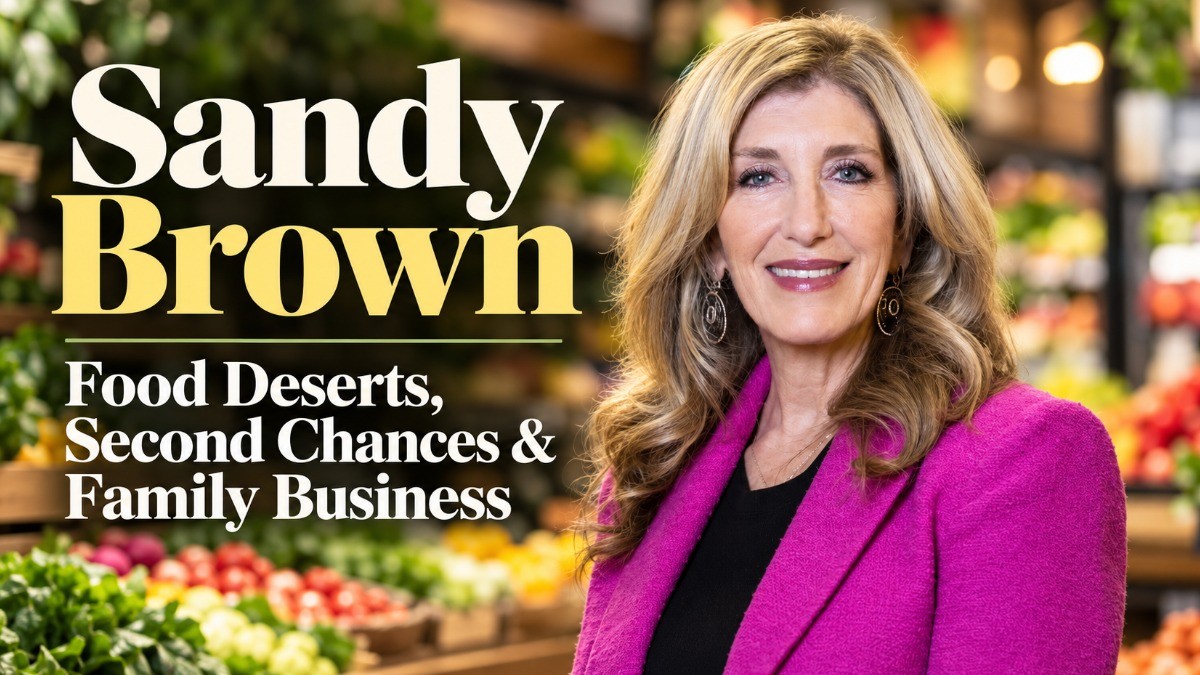
Sandy Brown of Brown's Super Stores on Food Deserts, Second Chances and Family Business
00:0000:00
Sandy Brown of Brown's Super Stores explains how opening ShopRites in Philadelphia food deserts led her family to hire returning citizens and build Uplift Solutions, a reentry nonprofit. Over a Saddlehill Proprietor's blend, a Napa red and a 1982 Château Margaux, she and host Bill Green talk business, marriage and second chances.
Sandy Brown is Executive Vice President and Chairwoman of Brown's Super Stores, which operates ShopRite, The Fresh Grocer and Di Bruno Bros. markets, and Co-Founder and Chairwoman of Uplift Solutions. Before her 30 years at Brown's, she spent more than a decade running regional and national operations for Unilever and Revlon; at Unilever she was one of three women managers in the entire country. She sits on the board of Wakefern Food Corporation, where she chairs the Customer Experience Committee, and on the board of the American Cancer Society.
She explains why most returning citizens Brown's hires use the job as a stepping stone, and why Uplift now offers expungement through Philadelphia Lawyers for Social Equity: even with a job, a record can keep someone from buying a house. She also describes taking over the business when Jeff Brown ran for mayor of Philadelphia, reopening the looted Parkside ShopRite in West Philadelphia within a week, and why Brown's stepped in to save Di Bruno Bros., a Philadelphia name since 1939.
Resources:
- Uplift Solutions
- Philadelphia Lawyers for Social Equity (expungement help)
- Di Bruno Bros.
- Saddlehill Winery
Sandy Brown's start at Unilever and Revlon
Bill Green: Welcome to Uncorked: Wine, Business and Life. I'm your host, Bill Green. On this show, we pop open some wine and dive deep into candid, unfiltered conversations about what it truly takes to build a business, navigate life and make a lasting impact. Today, I have the absolute privilege of welcoming a woman who is the epitome of saying, if you want something done right, give it to a busy person. She is an extraordinary executive, a passionate philanthropist, a dedicated mother of four, a grandmother and a deeply cherished friend to both my wife Amy and me. She earned her degree from the University of Maryland, Smith School of Business. She spent over a decade running regional and national operations for industry giants like Unilever and Revlon.
For the past 30 years, she has been a driving force at Brown's Super Stores, serving as Executive Vice President and Chairwoman. From shaping the customer experience, branding and public relations across 16 ShopRite stores, The Fresh Grocer and Di Bruno Brothers markets to leading e-commerce and retail technology initiatives, her impact on the grocery industry is unmatched. On top of all that, she sits on the Board of Wakefern Food Corporation, chairs the Customer Experience Committee and serves on the Board of the American Cancer Society. Beyond the corporate world, her heart for community is where she truly shines as Co-Founder and Chairwoman of Uplift Solutions. She works tirelessly to transform underserved communities, creating second-chance opportunities and helping previously incarcerated individuals successfully integrate back into society.
Her, along with her husband, Jeff, are two of our closest friends. She's raised four wonderful sons, welcomed two grandchildren recently in the last few years, and somehow still manages to navigate high-stakes business, deep philanthropy and a vibrant family life with grace, humor and endless generosity. Please welcome to Uncorked, Sandy Brown.
Sandy Brown: That was lovely. I don't know if I'm accomplished or just old.
Bill Green: Oh, yes, you are. Come on, you know. Hey, it takes a lot of work to get old, right? Well, actually, I was going to incorporate this into the intro, and I mentioned that we're really good friends, but it was a little creepy, listeners and viewers, because Browns have been following my wife Amy and I in residences for 25 years. We moved into the same neighborhood in Cherry Hill together.
We moved, next thing you know, they're down the street. We buy a house at the Shore, next thing you know, they're down the street. We buy a house in Philadelphia, they're frigging right across the street. They are the best neighbors. If you ever run out of sugar, you can always go and Sandy will have it for you, and just the best. Sandy, I've known you really a long time. Sometimes I have no clue how you do what you do. I mean, you juggle so many balls all at one time. And then if I say, hey, Sam, you wanna go out for a run? Okay, better be six o'clock in the morning, because you're gonna be rocking and rolling by seven.
What tips do you have?
Sandy Brown: Well, I think I've always had a lot of energy and never really required a lot of sleep. So that was one good thing, especially when I was raising my children and working full time and traveling. Just, you had to be organized. My kids say I am majorly OCD, which I am, and unfortunately I gave it to a lot of them, but, you know, I love what I do and all the different aspects. I probably would like to do more of some things than others, and it's been a long road, particularly working for Brown's Super Stores, starting very small and growing to where we are today.
It was a long road and a lot of work, but I always loved it. So I always had a lot of energy.
Bill Green: Yeah. So you get out of college and you go, you work in CPG, you know, a couple of really massive brands. You learn there more that was transferable to your family business than going to college, right?
Sandy Brown: For sure.
Bill Green: What do you think were some of the stepping stones working for those big guys that helped you navigate moving into Brown's and, like, as you said, small business to grow?
Sandy Brown: Mm-hmm. You know, it's an excellent point, because I look now at the young people today, and they're all really into startups.
But I think one of the things that made me successful long term was the structure of Unilever. And they were gigantic, and I worked in their Health and Beauty Care division, which ultimately was dissolved; they just took it broker. Before they did that, though, I ended up working here in Philadelphia. And within about 16 months, I was promoted to run the San Francisco market, which was highly unusual for them. They usually kept you in your region. For whatever reason, I went to San Francisco, and the structure that they provided you and the training really gave me a lot of those base strategies of how to be successful in business. And it was a dog-eats-dog world back then, especially for women.
I was one of three women managers in the entire country. Three. So, you know, people talked about the glass ceiling back then, and there really was, but it didn't seem to bother me. I just did whatever I had to do to get to the next spot.
Food deserts, returning citizens and Uplift Solutions
Bill Green: Explain to our audience what the niche is that you and Jeff have that's different than other ShopRite stores.
Sandy Brown: So in our business, we looked at it as a lot of different facets. Of course, obviously, you need to make sure profit, but we kind of added a social component, and it primarily had to do with the way we opened our stores. We opened one of the first food desert stores, which is down by the airport in South Philly at Island Avenue, and it had previously been an Acme where there was gun violence.
And so Jeff comes home and he's like, oh, I want to buy this store. And, you know, there was a shooting, but I think it'll be okay. And I'm like, what? But that really took us down a road of not just helping to open stores where there were food deserts, but once we got into those communities where we were very integrated, they really started coming primarily to Jeff with all of their problems. They didn't have a place to bank, so they were unbanked, so we opened a credit union. They couldn't get jobs because they had been in prison, and a large percentage of the men in these communities had been to prison and couldn't get jobs.
So that was kind of where we started, you know, well, it's no problem, you'll come work for us. And we started hiring returning citizens probably within the first few years that I was working at Brown's. I actually hired the first one, and I thought my director of loss prevention was going to kill me, but he was a man who had killed somebody when he was 18, and he was like 45. He'd been in jail all those years. He repented for his sins, and he just wanted to make money for his family, and I gave him a job on night crew, but that was kind of the first start of us just hiring people who are coming out of jail.
Bill Green: And you've had thousands, right, over the years?
Sandy Brown: Mm-hmm.
Bill Green: Talk about percentage of ones that kind of don't work out. Like, what percentage fail?
Sandy Brown: Ooh, that's a good question. I can't tell you exact numbers, but I will say majority of them, they don't necessarily stay with us, but they use it as a stepping stone to get to their next job. And I cannot tell you how many people have come back to me and said, I don't work for you anymore, but because I worked for you, I'm back in what I used to do. And that's fine. I didn't care if you used me as a stepping stone, if it was going to help you long term.
But one of our store directors, he's not from Uplift Solutions, our nonprofit, but he came in as a returning citizen, and he just worked diligently, and he makes six figures now, and he does great.
Bill Green: That's amazing. That's really great. But talk about Uplift and how that all tied together and what you guys are doing with it now, and this, you know, I know it's big.
Sandy Brown: Yeah. So we started it in 2009. And we really just started it as a website. Jeff had been asked to join the First Lady in her box at Obama's first speech for when he became President. And as we're driving down to DC, I'm literally trying to stand up a website, because I want people to be able to connect with us if his story inspires them, and it moved to really doing work with food deserts.
And then over time, it evolved into what we have today, which is more giving second chances and opportunities to people that are coming out of jail. So I took over as chairwoman, and not to say that this is because I'm doing it and Jeff isn't, but I really shifted the way that we operate from it being mostly Jeff's face, because, you know, let's face it, people knew him; he had a really great history in doing all of this work. But Atif, who was our Executive Director, I moved it more to him. And eventually, I elevated him to President and CEO of Uplift Solutions, and he has just done a great job partnering with the city.
In the past, maybe six months ago, we collaborated with another nonprofit that was kind of losing their way called PLSE, Philadelphia Lawyers for Social Equity, and they are now under our umbrella, and so we can offer their services, which are expungement. So even if I give you a job, if you still have a record, you still can't buy a house. There's so many laws that you would just not believe that you cannot do if you have a record like this. So we can help get rid of all of those things on their records.
Bill Green: Give us a sense of scale on how many folks you touch in a year and how big the organization is.
Sandy Brown: I would venture to say that we are helping within Uplift Solutions itself is probably about maybe 300, but our collaborations with North10, our collaborations with the city, if you expand it out, it's thousands, and I'll give you an example.
Do you remember when there was all the snow last winter, and they just could not get rid of this snow? So they asked Atif, we need you to help us. So they went and they bought them the boots, and they bought them vests to make sure that they could be seen. They got the shovels, and then they partnered with two other organizations: ODAAT, which is very big in the city, and Same Day Work and Pay filtered all of the payments. And we stood up, like, in a week, probably 600 people, 500 people to help shovel the city out. It was crazy.
A New Jersey blend and Brown's early years
Bill Green: Yeah. Hey, let's try our first one.
So the first one, I'm a little partial to, because it's my wine. And it was named after me. So that'll help. Proprietor's blend. So cheers.
Sandy Brown: Oh, cheers. You wanna talk about our Monday drinking fest?
Bill Green: Yeah, I went to her Di Bruno Brothers store, and we did a little film shoot for marketing, and yeah, 10 o'clock in the morning, Sandy and I were drinking wine and eating cheese.
Sandy Brown: 10 a.m. and eating cheese. Breakfast of champions. It was really good.
Bill Green: Very tasty, though. I mean, this is, you know, a classic Bordeaux blend, and I have a Bordeaux blend for us to finish with, and there's a bit of a price difference, so, but this is really a good one.
Sandy Brown: Wow. Very good.
Bill Green: And then I wanna go right to the second one. This one's got a little more Cabernet Sauvignon than the blend, but this is a Napa. And it's great. But again, and maybe I'm doing a little bit of a commercial.
Sandy Brown: Go for it.
Bill Green: But I'm okay with this for $45 versus this for $85. Not that big of a difference, right?
Sandy Brown: No.
Bill Green: And, you know, so I just gave a plug for New Jersey wine. Cheers.
Sandy Brown: Cheers.
Bill Green: Hey, so let's get into, you built a life and a business with your best friend. Jeff, he's such a good guy, and Jeff and I have had some great laughs and great family stuff, and he's sincere, and you guys just seem to figure out how to complement each other.
And I don't mean verbally, I mean just in everything you guys do. Sandy's out there at a Wakefern board meeting, and Jeff's babysitting his granddaughter, Hazel. I don't think either one of you came from a lot of money, right? It was, you did it the old-fashioned way, you earned it. And talk about those early years and some of the challenges that you guys were facing as a young couple, raising young children with all the things and running a business that's 2% gross margins.
Sandy Brown: Mm-hmm. Yeah, it was tough. And that's why I say the road, particularly when I moved over to Brown's Super Stores, is when I worked in CPG, I was traveling a lot, but I made some decent money, and we had two children, but when we were getting ready to open our second store, so Jeff had run our ShopRite of Roxborough for a number of years, pretty much on his own with his own people there, a manager, whatever.
And I came in to help him open the second store. And we really had no human resources to speak of, no training and development, anything in our company. And even though Wakefern would provide you some things, it wasn't really customized for your business, for what you were doing. So I started learning how to cashier. And I was actually training how to cashier. I was still working for Revlon, because I had, like, about a month period of time that I'd given my notice, and I started working in that business. And then my father-in-law got very sick. And he actually died right about the same time as we opened the second store. So it was a really difficult time, because Jeff couldn't even come to the opening, because he was, you know, mourning for his father, but we opened it, and it was a disaster.
The guy that was the manager, he quit. We were just a hot mess. We were trying to do these coupons, and at, like, nine o'clock at night, at eight thirty, nine o'clock, I'm calling customers to see what their experience was, and it was just terrible. And I'm probably, I don't know, maybe five months pregnant at this time. And we just keep working it and working it, and finally, over time, we hired another guy to help us, and it improved, but it took a long time to understand the Wakefern way and how to get the products in consistently. We'd have all these out of stock. I mean, nobody wants to shop if half your stuff is empty, so it took us a minute.
But I'd say by the time I was having Scotty, while I was pregnant with Scotty, we had really turned the corner.
Bill Green: Baby number four.
Sandy Brown: Yeah, we had turned the corner, and we just kept buying stores, and we had about four or five supermarkets by that time, and it's really getting from two to three. That's the hardest.
Bill Green: And look, you and Jeff are really, really, really as savvy financially as possible. You don't just open up your checkbook and say, I'm gonna buy this store, right? There's financing, there's land leases, there's ground, you know, there's building leases, there's all this kind of stuff, do I buy, do I, and then, of course, there's the Wakefern issue, right?
Sandy Brown: The largest co-op in the United States, and they are very complicated. And most people don't understand, like, I, you know, try to explain it, it's just not worth it, but all of us, you know, we work together as owners, so it's sort of like the franchise, but we also own the warehouse as well. So it's the simple version. But it was complicated, but the thing about Jeff was, really, he should have gone into the business of mergers and acquisitions. He loved buying the stores. He didn't love operating them or, you know, all of that, because it's Groundhog Day. Same stuff, same crap every day, so that was really where he excelled. He's unbelievable at that.
Bill Green: Yeah. Matter of fact, I've heard other ShopRite owners say Jeff is about as sharp as you get in finance.
Sandy Brown: Yes.
Bill Green: And it's probably something like, the grocery business is not finance guys, they're grocers. Right? So to have that skill set, he grew up as a grocer. He grew up in a grocery family. And then he has, look, Jeff went to Babson, and he's a really smart dude.
Jeff Brown's mayoral run and Josh as CFO
Bill Green: Anyway, okay, so I don't want to ask about what you guys talk about when you're laying in bed together. But how the hell do you work together, live together and deal with all this stuff without killing each other?
Sandy Brown: Yeah. Well, I'd say in the early years, it was his business.
He was the president. Whatever they needed me to do, I did. So I think that fact that I didn't ever refute anything with him in front of anybody, you sort of have to know your role and know your boundaries. But because we're very like-minded.
Bill Green: Why are you looking at Amy?
Sandy Brown: We're very like-minded.
Bill Green: I got it, right.
Sandy Brown: Was very self-conscious, right? We're very like-minded, and we really kind of, you know, we just sort of see things the same way. So because of we're so aligned, it just worked out always since we're young. Jeff woke up one day and said, I think I'm gonna run for mayor of Philadelphia. And my first reaction was...
Bill Green: You're gonna say you've lost your mind.
Sandy Brown: Right. Everybody said that. They were all like, wait, what? Yeah, when you told me that, I said, and if did he you want to do this, then you're giving me the business to run. I don't want to have anything, and I went on a, like, a route where I was just starting to separate everything. Uplift was in our offices. Like, that was my first thing, like, we were just.
Bill Green: But that was, like, the pivot point, right, for you to take over the, right?
Sandy Brown: It was. I had to do the separation and just because it didn't matter. I mean, we were helping them and just keeping them stable. But I walked in and I'm like, you gotta get out.
It's time. I mean, I had been trying to have them do that anyway, because they really need to be on their own, but just separating things, because I knew it was gonna get ugly, and it did.
Bill Green: And he ran an amazing race, and, you know, just for what he did to bring so many different things in the city of Philadelphia light, I think just benefiting, I think the city won by Jeff Brown running for mayor.
Sandy Brown: I appreciate that. That's very nice. I think, if people ask him all the time, are you going to run again? And he says, you know, no, Sandy, you know, he blames it on me. But we do agree in the fact that as a private citizen, in the position he's in, you can accomplish a lot more than you can as a politician, and I truly believe that, so.
Bill Green: There's no doubt. But let's talk about Josh, because Josh is now in the business. I mean, four really smart kids. Josh is the oldest. And he is Chief Financial Officer. And that was hard, even convincing him to come in, right? It wasn't like, these are not kids that just decide that I'll just wait for mommy and daddy to hand me a paycheck. I mean, these kids are drivers. Talk about Josh and how that all transpired.
Sandy Brown: Yeah, well, he was doing really well in Florida, working in private equity and real estate development. And he loved it, and they loved him. And I think that the guy that owned that business was very disappointed that Josh left, but I think he always knew this was his calling and that he was gonna come in.
And really, Alex, it's not even just that you have to be good with accounting and finance, and maybe it was somebody would come in as something else than CFO. But you have to like this business. Otherwise, what are you doing? Especially the generations today. It's all about enjoying the business and work-life balance, and a lot of them don't want to work more than 30 hours, you know. There's just a whole shift that I see coming, but he did like the business, and he went and he worked in every department, and he ran a store. We didn't make him a store manager, because that would have been pushing it a little bit, but he did help run the store that was the food desert that I was talking about earlier, the Acme where there had been a shooting, and Acme walked away from that community, and so, you know, he enjoyed the business, and he just embraced it, and he's done a great job since.
Bill Green: Yeah, he's terrific.
COVID and the looting of the Parkside ShopRite
Bill Green: Sandy, talk about when COVID hit.
Sandy Brown: Oh, God.
Bill Green: Supermarkets were financial winners, right?
Sandy Brown: Yes.
Bill Green: But you guys in particular had some pretty heartbreaking stuff happen when the Fox Street store got looted and broken into, and, you know, talk about that. And you felt, oh my God, we're helping these people, and next thing you know, they're trying to hurt us.
Sandy Brown: Yeah. And so, like, I'll give you a little insight into it. And the store, really, Fox Street did get hit, but Parkside in West Philly was the one that really just got annihilated. And it turns out, it wasn't really people from that community. It was disruptors that came in from other areas to try to drive all this chaos, because one of my managers, returning citizen who's been with me for 20 years, we helped him get everything expunged so he could buy a house, great guy.
He ran that store, was one of the managers. They had, like, a team of four people. And he stood there, 'cause we always tell him, just get out of the way. It's stuff. Don't put yourself in harm's way, just move. And so he got out of the way, and they just piled in the store, they broke all the doors, they piled in the store. He said he did not recognize a single person. They were not our shoppers. So it turned out that that store, some guy was actually on social media filming in the store, it went viral. And the community came and they helped us clean it up, and Wakefern, of course, came in, and we turned it around, we opened it back up in a week. So I think the biggest disappointment was just, like, there was so much going on at that time, and this was just like another layer, because our people were exhausted.
When everybody retreated into their homes, they had to go to work. We had to open. And I remember the first day driving on the Schuylkill Expressway, and it was like the Twilight Zone. There were no other cars on the road but me. I was driving out to Fox Street, and, you know, look, we opened and we opened every day, our normal hours, metered people in and out. It was a really crazy time.
Bill Green: Yeah.
Why Brown's rescued Di Bruno Brothers
Bill Green: And then, I mean, you guys are entrepreneurs, are risk-takers, right? And you have to take risks to succeed. So you guys are pretty much flying pretty high. And you have a business where you have some, I'll call it, market-rate stores and neighborhoods, and then you have the desert stores, which are much more difficult to run.
And then you take this giant leap and take a brand that's been in Philadelphia for over 100 years, right? Di Bruno Brothers. And you guys buy the company. And it's a totally different kind of business. And you guys fix it. And it takes you some time. And talk about that and the challenges you have there. I mean, it's amazing cheese and food. And if you've ever been into the store, I've gone multiple times to the Rittenhouse store, and it's just unbelievable. It's like, kind of nothing like it.
Sandy Brown: Yeah. I mean, the truth is that brand would have gone away if we had not stepped in. Nobody else was coming to the table, because it was very, very distressed. They had extended to a lot of locations.
The people were upset that we closed down Ardmore and Wayne, but they had really just expanded this business without a strategy. But they had amazing brand equity like I've never seen. Will go and I'll be talking to people, they don't care about ShopRite, they don't care about The Fresh Grocer, which are the ones that really do the business. As soon as I say Di Bruno Brothers, people's eyes light up. You know? And so I still partner with Penn Charter a little bit, where my kids went. So I go and I speak to the middle schoolers. I'm speaking to sixth graders. As soon as I'd say Di Bruno Brothers, they get so excited.
I'm like, how do you know Di Bruno Brothers? You're in sixth grade. Oh, my parents shop there. It was amazing. So it had amazing brand equity. It just had a lot of problems. And we just had to rightsize it. And it's not perfectly fixed. I mean, it still loses a lot of money. But we are committed, because we love the brand. The family just had an incredible heritage and legacy. And so we wanna keep that in place.
Tasting a 1982 Château Margaux
Bill Green: Okay. Last one of my options.
Sandy Brown: Oh, now we move to the Margaux.
Bill Green: It's one of my all-time favorites. And I don't go deep with many wines like this out of my personal cellar there, Sandy Brown.
And this is a 1982 Margaux. Okay, we don't need to talk about the value of this wine, but it's probably 20 times, if not more, worth what these other wines are worth. So I wanna know what you think.
Sandy Brown: Okay. I'm gonna taste it now. Oh, that's delicious.
Bill Green: Right?
Sandy Brown: You know, I was in Margaux, and I stayed at a place called Château Margaux. This is many years ago, Jeff and I went there. And it so happened that the guy that was running Château Margaux, their kid came to visit, and so he went into the cellar underneath there, it's all cobwebs under there. You can see some of them, and he pulled out a really old bottle.
And at the time, they weren't even doing tastings in Bordeaux. He pulls out this really old bottle, and everybody got, I mean, if I could tell you, it was a drop. It was such a small amount. And it was thin. It was really old. It was like from the 1950s. It didn't even barely have any flavor.
Bill Green: Yeah. Well, look, it's gonna change from year to year. Some wines are gonna hold up. I mean, I have some '82 Lafites that, you know, if I was gonna drink one, and from time to time I do, that's gonna decant for a few hours. It's young. It's gonna be around till 2050.
Sandy Brown: Really?
Bill Green: Yeah. It's really. I mean, learning about these wines is just absolutely.
Sandy Brown: Delicious. This is delicious.
Bill Green: Yeah. Okay.
The Uncorked lightning round
Bill Green: All right, Sandy, I started something new.
Sandy Brown: Great.
Bill Green: I'm really happy to do this with you. It's called the Uncorked Lightning Round.
Sandy Brown: Okay.
Bill Green: Okay? So you can give me a one-word answer, a two-word answer, you can expand anything you want to do.
Sandy Brown: Okay.
Bill Green: All right? End of a long week. Well, I actually shouldn't say that, because one of the wonderful things about being Sandy and Jeff's neighbor is you can get a text after dinner and say, what are you guys doing? Nothing, watching TV, come over for a glass of wine. So I really shouldn't even ask you this question.
Red, white or rosé?
Sandy Brown: Red.
Bill Green: Yeah, I knew that. I knew that answer.
Sandy Brown: Yes.
Bill Green: Okay. What is the go-to grocery store aisle when nobody's watching?
Sandy Brown: For myself?
Bill Green: Yeah.
Sandy Brown: I would probably say, well, I'm really big into our seafood. I love walking the seafood area. The aisles these days, it's really about the perimeter. So more than an aisle, I'd say it's the seafood department and looking at what are the fish we're carrying and where can we expand. I love evaluating the seafood.
Bill Green: Yeah, it's actually funny, because my first career was in the hardware business.
Sandy Brown: Yes.
Bill Green: And a pretty big business. And I gotta tell you, I love going into little hardware stores, little, like that Rittenhouse hardware store?
Sandy Brown: Yes, I love that hardware store.
Bill Green: I just got that smell into it. I just kind of walk around and I love it. Okay. Favorite family memory with Jeff and the boys.
Sandy Brown: I loved when we would all go in the snow together when they were little boys. So probably days out in the snow in our first house in Cherry Hill on Doris Drive, when they were very little.
Bill Green: Okay. If you were not in this business, what would be your dream career? And there's a lot of people waiting to hear this answer, because this is always a tough one.
Sandy Brown: My dream career, if I had the capabilities, I would love to be in the music industry.
I love music. I have a very mediocre voice, but I love to sing. And people will tell you, if you ever ask my kids, when I run in my house on my treadmill, I sing. And what I do is I'm like singing, singing, then there's nothing, and then all of a sudden I'll go, yeah, I just sing different parts of what's on the music. But I would be in the music industry if I had to, at least.
Bill Green: You sing in the shower?
Sandy Brown: No. Only when I'm running on my treadmill.
Bill Green: Would you want to be an actress or a singer?
Sandy Brown: Singer.
Bill Green: Okay, got it. We have something in common there, because I've always, probably why I have a podcast, I'm being the camera.
And I can't sing. But I took up a little hobby less than a month ago. And because I wanted to be able to decompress, and I love music, I'm teaching myself how to play the harmonica.
Sandy Brown: The harmonica.
Bill Green: 'Cause I can put it in my pocket. I could take it anywhere. I could have one everywhere, you know. And I love it, and I think, you know, I don't think I'll ever be able to, I don't know, maybe I'll be able to play a song someday. You know, I could play "Twinkle, Twinkle, Little Star." I'm trying to teach myself "Piano Man."
Sandy Brown: Oh, that's cute.
Bill Green: Sandy, we know you guys a long time.
And know the boys are not living at home anymore, but if you can think back, what would be a word that described the Brown family on a Sunday afternoon?
Sandy Brown: On a Sunday?
Bill Green: On a Sunday afternoon.
Sandy Brown: How about a Saturday night is a more exciting word?
Bill Green: Well, you guys are exciting. You guys like having parties, and you like entertaining people, and there's always lots of people around. Well, give me a Sunday afternoon.
Sandy Brown: Sunday afternoon.
Bill Green: 'Cause you, Jeff wasn't really a big sports guy.
Sandy Brown: Mm-mm.
Bill Green: Right.
Sandy Brown: No, 'cause by Sundays we were, like, toning down a little bit, doing homework or whatever. But I would say, you know, there was always something going on in our house.
If it wasn't with one kid, it was another that, you know, there were friends there, there was just always something happening. So, you know, for one word, action-packed.
Bill Green: I'll give you a hyphenated one. Sandy, this has been absolutely fantastic. You've been an amazing guest. I know you are gonna inspire a number of people, and especially young women, and they're out there figuring out how they're gonna plot their career. So thank you so much for being here. Cheers. A several little cheers here at the '82 Margaux.
Sandy Brown: Oh, this is so good.
Bill Green: I don't know if I just make this a little longer episode. Anyway, again, Sandy, thank you very much.
Sandy Brown: Thank you, Bill. Appreciate it.
Bill Green: And our viewers and our listeners, thank you for joining. Hit subscribe, and see you next time.